

Read the story then discuss the questions at the bottom of the page.
By the time Emma reached the station, she had already decided it had been one of the worst days she’d had in months. A meeting had gone badly, she’d missed lunch while answering emails, and just as she had been leaving the office, her manager had handed her another report to finish before Monday. All she wanted was a quiet journey home.
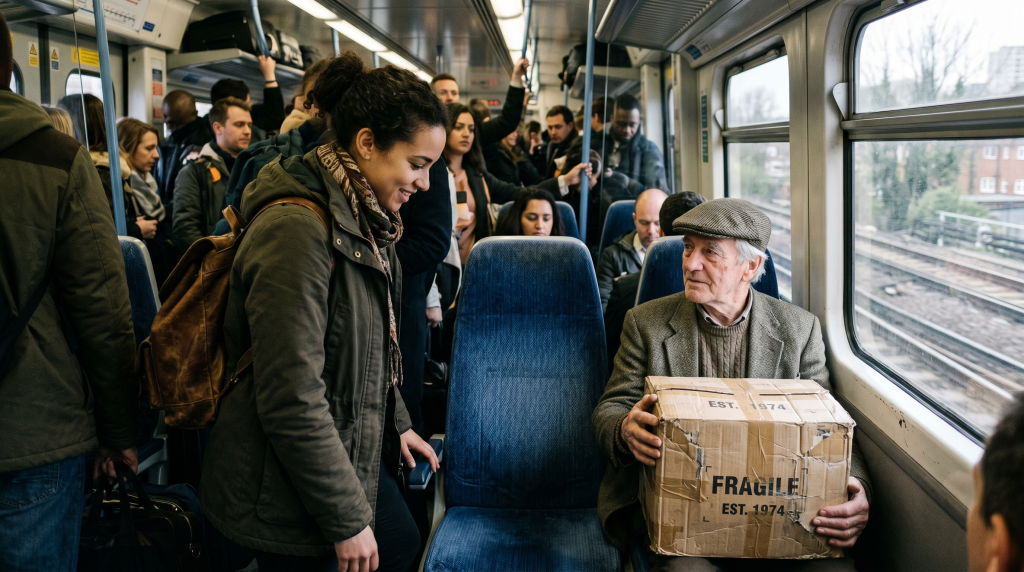
When the train arrived, she stepped into a crowded carriage and looked for an empty seat. There was only one. It was opposite an elderly man who was holding a battered cardboard box on his lap. The box had been repaired with strips of brown tape, and its corners were worn, as though it had travelled many miles.
“Excuse me,” Emma asked. “Is this seat free?”
The man looked up and smiled.
“Of course.”
She thanked him and sat down. For several minutes neither of them spoke. As the train moved out of the station, Emma found herself glancing at the box. Eventually, curiosity got the better of her.
“I hope you don’t mind me asking,” she said, “but what’s in the box?”
The man smiled.
“It’s a long story.”
“I’ve got an hour,” Emma replied.
He laughed softly before answering.
“My wife and I bought an old sailing boat over thirty years ago. Everyone thought we were wasting our money. Every summer we’d spend our weekends repairing it. We replaced rotten wood, painted the hull and rebuilt the cabin. We were never in a hurry. Restoring the boat became part of our lives.”
He paused for a moment.
“We had almost finished when my wife became ill. After she died, I couldn’t bring myself to work on it again. Every tool reminded me of her.”
Emma listened quietly as the countryside slipped past the window.
“A few years later, my grandson asked if we could finish it together. We’ve been working on it ever since.”
He rested his hand on the box.
“This contains the final piece.”
“The final piece?” Emma asked.
He carefully lifted one corner of the lid. Wrapped inside was a polished wooden nameboard with beautifully carved letters.
“My wife carved it herself,” he said. “Tomorrow my grandson and I are finally going to attach it to the boat before we launch her next weekend.”
For a few moments they sat in silence.
Then Emma smiled.
“You know, I nearly didn’t sit here.”
“Really?”
“I thought you wanted to be left alone.”
The man chuckled.
“And I nearly put my coat on the seat because I assumed nobody would want to sit opposite an old man carrying a scruffy cardboard box.”
They both laughed.
As the train slowed into Emma’s station, she stood up and picked up her bag.
“I’m glad neither of us was right,” she said.
“So am I,” the man replied.
Walking home, Emma realised she hadn’t thought about work for almost an hour. The problems waiting for her on Monday hadn’t disappeared, but they no longer seemed quite so important. Sometimes, she reflected, the most memorable journeys begin with something as simple as choosing the last empty seat.
Questions
1. Why did Emma decide to speak to the elderly man, even though they had been sitting in silence?
2. What do you think Emma learnt from her conversation on the train? Explain your answer using evidence from the story.
Language focus: Narrative tenses
3. The story begins:
“By the time Emma reached the station, she had already decided it had been one of the worst days she’d had in months.”
Why does the writer use the Past Perfect (had decided, had had) here instead of the Past Simple?
4. Read this sentence:
“We had almost finished when my wife became ill.”
What does the Past Perfect tell us about the order of these two events? Rewrite the sequence in your own words.
5. Look at these two sentences from the story.
“She thanked him and sat down.”
“As the train moved out of the station, Emma found herself glancing at the box.”
Why does the writer use the Past Simple in the first sentence and the Past Continuous form (was glancing is implied by found herself glancing) in the second? What effect does this have on the story?