

Your position: You’re not convinced either way. Technology is neither automatically good nor bad. You think the important questions are who controls it, who has access to it, how it is used and what problem we’re actually trying to solve.
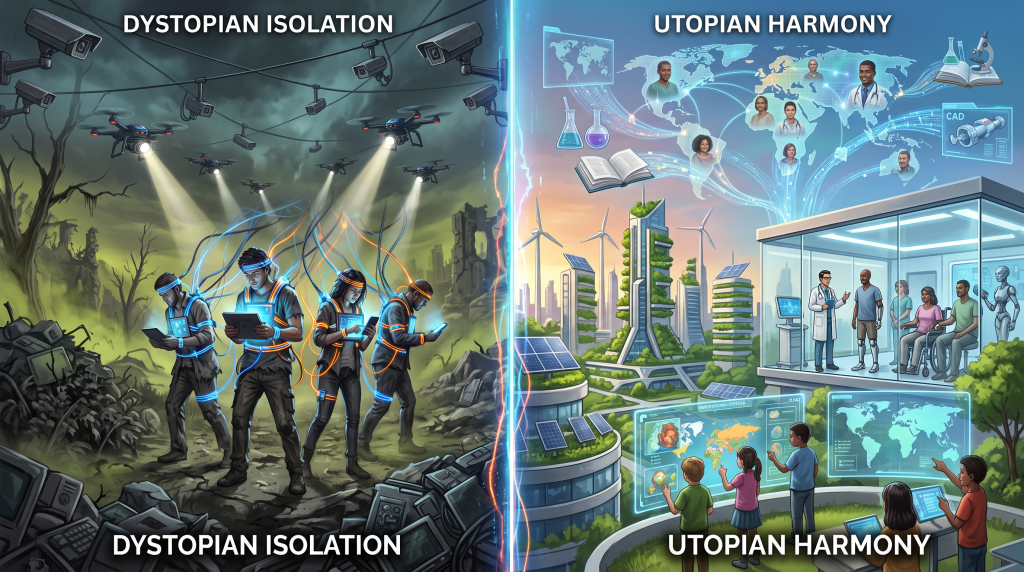
Facts and statistics
- Vaccines have saved an estimated 154 million lives, but access remains unequal. In 2022, 33 million children missed at least one of the two recommended measles vaccine doses. World Health Organization
- Renewable technology is expanding rapidly, yet current climate policies still leave the world facing serious warming. UNEP estimated that continuation of current policies would put the world on a trajectory of around 3.1°C of warming this century. WeDocs
- Renewable energy can reduce emissions, but producing phones, computers, batteries and other technology requires materials and creates waste. Only 22.3% of e-waste was formally collected and recycled in 2022. World Health Organization
- The same technology can have very different effects depending on how it is used. The internet can provide education and spread misinformation; AI can assist doctors and generate convincing false information.
Prepare your arguments
- When does technology solve a problem, and when does it simply change the problem?
- Is the real issue technology, or human behaviour?
- Who benefits most from new technology? Who might lose?
- Is inventing a solution enough if millions of people cannot afford or access it?
- Which problems need political or social change rather than technological solutions?
- What evidence would persuade you to become a believer or a sceptic?
Your challenge: Don’t simply say “both sides have a point”. Prepare questions that expose weaknesses in both positions and decide what conditions would need to be true for technology to solve a problem.